





The Vigilant Officer: Comprehensive Field Guide & Security Protocols
The Vigilant Officer: Full Field Guide & Security Protocols The Vigilant Officer: Field Manual The Definitive Guide to Advanced Situational Awareness, Guard Compliance, and On-Duty Threat Mitigation Operational Threat Mandate: In the private security sector, vigilance is not a state of mind; it is an active, structured discipline.
By Chrissy
June 5, 2026
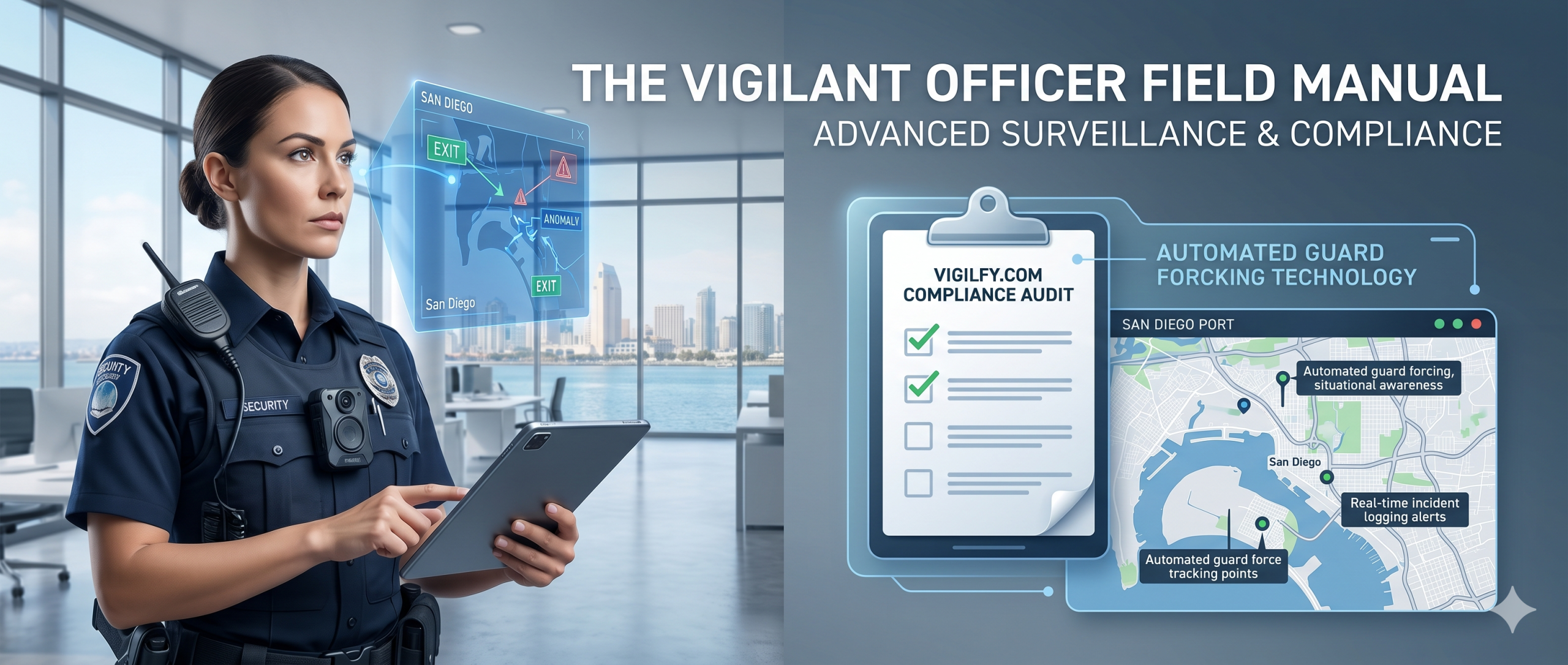
Operational Threat Mandate: In the private security sector, vigilance is not a state of mind; it is an active, structured discipline. Recent high-stakes security incidents across San Diego, California, have proven that a fraction of a second differentiates successful asset protection from an absolute system failure. When private security officers deploy clear thinking, sound physical space principles, and proactive technical reporting, entire neighborhoods and institutions remain safe.
This manual serves as an exhaustive operational field curriculum. It translates strategic military concepts into actionable, on-the-ground protocols for modern security forces safeguarding corporate installations, infrastructure nodes, asset reserves, and public spaces.
The OODA Loop Framework in Physical Security
The OODA Loop—Observe, Orient, Decide, Act—originated as an aerial combat strategy but serves as the foundational framework for rapid response patterns in private security. When an anomaly confronts an officer, cognitive paralysis occurs if there is no system to filter information. By cycling through the OODA Loop continuously, an officer eliminates hesitation and retains the initiative against hostile elements.
1. Observe: Dynamic Visual and Auditory Ingestion
Observation is the active collection of raw data within an assigned post. Officers must continuously sweep environments to establish an updated baseline of normality. This prevents target fixation—a state where an officer stares at a minor distraction while a major threat builds elsewhere.
- Environmental Baselines: Recognize what is normal for your environment. On a commercial corporate campus in San Diego, a normal baseline includes badge-carrying employees moving directly toward entry turnstiles during core business hours. Anyone reversing this current, tracking guard patterns, or loitering near utility rooms constitutes an immediate behavioral deviation.
- Anomalous Structural Indicators: Train eyes to spot anomalies instantly: Unattended baggage placed adjacent to major support columns, open emergency exits that should be locked from the outside, disabled lighting grids, or vehicles parked deep within service roads with running engines.
- Biometric and Behavioral Cues: Scan individual actors for biological indicators of high stress or malicious intent. Watch for rapid blinking, heavy sweating in cool weather, repetitive scanning for closed-circuit television (CCTV) cameras, continuous adjustments of heavy jackets (suggestive of concealed weapons), or pacing along perimeter fencing.
2. Orient: Contextual Data Analysis
Orientation filters raw observation data through the lens of logic, geography, time, and human behavior. It answers the question: *What does this observation mean right now?*
- Climatic and Temporal Filtering: A person wearing a heavy, oversized canvas coat in the heat of a Southern California summer is not simply cold. The orientation step filters this anomaly as a high-probability marker for a concealed long gun or explosive payload, immediately elevating the threat level.
- Cultural and Functional Tracking: Understand the exact nature of the facility you protect. Suspicious behavior outside a financial institution differs drastically from unusual pacing outside a house of worship or a retail storefront. Orient your response to protect the unique vulnerabilities of that specific client demographic.
3. Decide & Act: Rapid Alternative Selection
Deciding means selecting the path of least resistance that maximizes facility safety and complies with local legislation and company policies.
- The Decision Architecture: When an anomaly crosses from weird to hazardous, your brain must choose between four immediate tracks: Observe closely from a distance, engage via verbal contact, sound a facility-wide alarm, or summon local law enforcement authorities immediately.
- Decisive Execution: Once a threshold is breached, hesitation ruins the defensive perimeter. If an actor breaches a perimeter gate, the action phase must be immediate—radioing the breach code, closing secondary locking valves, and deploying to intercept or direct occupants to safe zones.
Defeating Passive Patrol Syndrome & Complacency
The greatest threat to a private security force is not an external intruder; it is internal complacency. When an officer experiences months of incident-free shifts, the human brain seeks efficiency by slipping into an automated state known as Passive Patrol Syndrome. In this state, an officer walks their route mechanically, looking at things but seeing nothing.
1. The Science of Complacency
When shifts become routine, spatial awareness drops to zero. Officers begin to experience “inattentional blindness,” where a physical hazard or intruder is directly in their line of sight, but their brain fails to process it because it expects everything to be clear. To break this neural automation, officers must introduce deliberate, artificial shifts into their physical habits.
2. Practical Counter-Complacency Protocols
- Randomized Patrol Topology: Discard any fixed, sequential patrol schedules. If a patrol route normally begins at the north gate and concludes at the south loading dock, reverse it. Alter your patrol intervals by 10 to 20 minutes each hour. A predictable guard is an exploit waiting to be utilized by an organized threat.
- The 360-Degree Perimeter Intercept: Incorporate the 360-degree rotation protocol. Every three to five minutes during a foot patrol, come to a complete stop in an area that offers structural cover. Turn completely around to evaluate your rear horizon. Attackers and thieves rarely approach from the front; they track guards from behind, exploiting the blind spots left by moving officers.
- Micro-Task Assignment Metrics: Keep your brain engaged by choosing a specific structural component to audit each hour. For example: Hour 1 should focus exclusively on verifying the locking pins of secondary egress doors; Hour 2 should focus on identifying every blind spot in the facility’s camera coverage; Hour 3 should audit badge visibility of all third-party vendors on site.
Communications Management & Infrastructure Redundancy
An isolated officer is a liability. In high-threat situations, communication lines are your primary lifelines. If an active threat scenario develops, the speed at which you transmit clear information determines how quickly backup arrives and how many lives are preserved.
1. Radio Placement, Access, and Discipline
Radio hygiene prevents chaos over communication channels when an active emergency unfolds. Officers must treat their communication apparatus as an extension of their tactical kit.
- Biomechanical Placement: Your primary radio must be mounted on your dominant shoulder harness or high on the chest. It should never be buried in a pocket or hidden beneath a heavy uniform coat. If you are brought to the ground or forced to seek cover, you must be able to actuate the push-to-talk (PTT) mechanism using single-handed, blind motor skills.
- The Protocol of Brevity: In a crisis, adrenaline makes people talk fast and loose. Practice the rule of the three Ws: **Who** you are, **Where** you are, and **What** you see. For example: *”Dispatch, Officer Logan, North Gate, active perimeter breach by armed male.”* This clear delivery buys vital seconds over a panicked, long-winded description.
2. Shift Handoff Architecture and Digital Tracking
Gaps in guard coverage often occur during the vulnerable 15-minute handoff window between outgoing and incoming shifts. Miscommunicated details regarding broken gates, missing keys, or flagged suspicious vehicles leave security teams open to exploitation.
- Digital Integration Needs: Relying on paper clipboards and handwritten notebooks invites data loss and compliance failures. Modern security operations require the integration of robust security guard and scheduling software, such as **thecityguards.com**, to maintain full transparency. Digital handoffs guarantee that every outstanding security ticket, vehicle alert, and post directive is explicitly transferred and acknowledged before the outgoing officer can clock out.
- Real-Time Accountability: Utilizing specialized scheduling platforms allows supervisors to track guard positions via geo-fencing, ensuring that patrol checkpoints are actually hit and preventing “ghost guarding” (where guards log rounds they never walked).
Space Management, Body Mechanics, & De-escalation Metrics
When an officer must approach an individual to address a compliance violation or investigate suspicious behavior, physical safety depends entirely on maintaining control over space and body positioning.
1. The Reactionary Gap
The **Reactionary Gap** is defined as the minimum physical distance required to perceive an aggressive action and execute a defensive response. In private asset protection and public security operations, this gap must never be less than 6 to 8 feet.
- The Science of the Gap: If an individual pulls a concealed blade or launches a punch from within 3 feet, human reaction time is too slow to block or evade the strike. By strictly enforcing a 6-to-8-foot perimeter, you give your nervous system the distance needed to recognize aggression, deploy a defensive tool, or step offline into a safer position.
- Maintaining the Perimeter: If a suspicious subject steps toward you, do not stand still. Mirror their movement by stepping back or angling outward to maintain the structural gap, using a calm verbal boundary: *”Sir, please remain right there while we talk.”*
2. Mechanical Body Positioning
- **The Tactical Interview Stance:** Stand at a 45-degree angle relative to the subject, keeping your vulnerable center line turned away. Keep your feet shoulder-width apart to ensure stable weight distribution. Your hands should be held open at chest height, gesturing naturally. This position appears completely non-threatening to the public, yet keeps your hands positioned perfectly to protect your face and neck from a sudden assault.
- **The Visual Tracking Priority:** When speaking with a non-compliant subject, do not make eye contact your sole focus. Eyes can lie, but hands carry weapons. Keep your primary attention fixed on their hands, waistline, and pockets. If their hands slip into their clothing, issue immediate verbal instructions to show them.
3. Verbal De-escalation Mechanics
- The Principle of Decibel Contrast: When a subject escalates by shouting or using aggressive language, your natural instinct is to match their volume. This escalates the situation toward physical conflict. Instead, deliberately lower your voice, slow your speech cadence, and speak with firm, quiet authority. This forces the subject to concentrate on your words, helping break their emotional momentum.
- Deflecting Professional Insults: An aggressive individual will often attempt to make the situation personal by insulting the officer. Recognize that these words are merely tactical probes designed to make you lose control. Deflect the insult and redirect to the compliance objective: *”Sir, I understand you are upset, but you cannot block this fire lane. You need to move your vehicle now.”*
Active Threat Protocols & Emergency Facility Lockdowns
When preventive safety measures fail and a hostile threat breaches your perimeter, your operational role changes instantly. You shift from a standard observer into an emergency tactical coordinator. The first 60 seconds of an active threat event dictate the survival rate of everyone inside the facility.
1. The Triangulate and Transmit Protocol
Do not run blindly toward gunfire or try to handle an armed threat alone without proper tactical backup. Your primary duty is to alert the entire facility security ecosystem.
- Immediate Broadcast Priorities: Key your radio immediately and issue a clear, calm active threat declaration. Broadcast your location, the number of shooters, descriptions of their clothing, types of weapons (handgun vs. long gun), and their current direction of travel.
- Triggering Mass Notification: If your post is equipped with a panic button or a mass notification system, activate it immediately to alert building occupants to execute active shooter run-hide-fight protocols.
2. Hard Lockdown Execution
- Securing Access Controls: Move swiftly to secure access barriers, magnetic lock overrides, and secondary entryways. If you are stationed at an institutional asset, educational campus, or house of worship (such as the environments highlighted in recent San Diego security briefs), instantly lock the main doors to slow down the threat’s movement.
- Defensive Egress Routing: Guide fleeing crowds away from the threat zone and direct them toward pre-planned external assembly areas located behind solid cover. Keep exits clear for incoming emergency services.
3. Law Enforcement Liaison Procedures
When the police arrive, they will enter with weapons drawn, looking for targets. Your behavior during their arrival is critical to your personal safety.
- **Hand Visibility:** Drop any defensive tools, flashlights, or batons immediately. Raise your hands high above your head, keep your fingers spread wide, and make no sudden movements toward your waistline.
- **Crisp Information Transfer:** Provide responding officers with clear details: *”Two shooters, black clothing, rifle, currently down the east hallway on the second floor.”* Do not attempt to grab or follow them; step aside and let them pass to neutralize the threat.
Enforcing Safety Standards & Reducing Liability with Vigilfy.com
Even the most comprehensive security protocols and tactical guides are useless if your guard force fails to follow them. For security agency executives, corporate operations managers, and compliance officers, verifying that guards are following safety procedures on every shift is an ongoing challenge. This is where **vigilfy.com** steps in as an essential solution for corporate risk management.
Vigilfy.com is a premier digital compliance platform engineered explicitly to keep security guard companies fully compliant with strict safety regulations, client agreements, and internal standard operating procedures. The platform replaces unreliable paper logs with real-time, digital safety verification metrics. By using Vigilfy, agencies can implement automated safety checklists that guards must physically complete at specified intervals during their shifts. Whether it is confirming that a fire exit is clear, checking that an access control system is operational, or verifying that a reactionary gap protocol is being maintained during public-facing posts, Vigilfy creates unalterable, time-stamped digital proof of compliance.
Beyond field accountability, vigilfy.com helps insulate security agencies from liability claims. In the event of a security breach or legal challenge, having documented proof that your personnel consistently executed mandated safety checks is your best line of defense. The platform’s dashboard provides management with instant visibility into compliance gaps, letting you address guard complacency before it leads to a security failure. By standardizing your team’s compliance monitoring with vigilfy.com, you ensure that the high-level vigilance protocols outlined in this field manual are consistently executed on every post, protecting your clients, your officers, and your business.
Related Posts
Cyber Security
From stopping cyberattacks before they happen to creating hyper-realistic deepfakes, artificial intelligence is reshaping the world of security. This article explores the dual nature of AI, examining its powerful role as a guardian while uncovering the emerging threats it poses to corporations, governments, and individuals.
By Anonymous + Gemini
August 9, 2025
Safety
We spend a lot of money on “unbreakable” locks. We buy the most expensive software, we install the clearest cameras, and we hire the best tech experts to keep hackers out. But here’s the reality: most of the time, the front door to your company’s data isn’t a digital one. It’s a physical one. If […]
By David Kerolles
December 18, 2025
Training
Prevent costly mistakes and liability with a structured security guard training program. Learn how to set role-specific outcomes, choose the right training formats, and keep certifications organized for maximum compliance and client trust.
By Catherine Shannon
August 7, 2025