
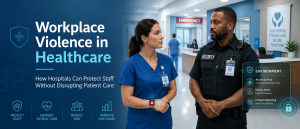



Workplace Violence in Healthcare: How Hospitals Can Protect Staff Without Disrupting Patient Care
Introduction: Hospitals Must Heal, But They Must Also Protect Hospitals are built for healing, but the modern healthcare environment is becoming one of the most unpredictable workplaces in America. Every day, nurses, physicians, receptionists, behavioral health teams, security officers, and support staff step into environments where emotions are high, wait times are long, families are […]
By Leila Monroe
July 1, 2026

Introduction: Hospitals Must Heal, But They Must Also Protect
Hospitals are built for healing, but the modern healthcare environment is becoming one of the most unpredictable workplaces in America.
Every day, nurses, physicians, receptionists, behavioral health teams, security officers, and support staff step into environments where emotions are high, wait times are long, families are under pressure, and patients may be experiencing pain, fear, confusion, or crisis. In many facilities, that pressure is turning into verbal threats, harassment, intimidation, physical assaults, weapons concerns, and violent incidents that can happen without warning.
For healthcare leaders, the challenge is not simple. A hospital cannot operate like a courthouse, airport, or correctional facility. It must remain open, compassionate, and accessible. Patients need care. Families need answers. Ambulances need fast access. Clinical teams need movement. At the same time, healthcare workers cannot be expected to accept violence as part of the job.
This is the new reality of healthcare security: protecting people without interrupting care.
Workplace violence in healthcare is no longer only a security department issue. It is a staff safety issue, a patient-care issue, a compliance issue, a workforce retention issue, and a leadership issue. When staff do not feel safe, the entire care environment suffers.
The future of hospital security will not be solved by one tool, one policy, or one officer at the front door. It requires a layered model that combines trained security officers, clear workplace violence prevention policies, staff education, duress alerts, access control, visitor management, weapons detection where appropriate, incident reporting, and leadership review.
Most importantly, these systems must work together.
The goal is not to make hospitals feel guarded. The goal is to make care feel safe again.
Why Workplace Violence in Healthcare Is Rising
Healthcare environments are unlike most other workplaces. They are open for long hours, often 24/7. They serve people in pain, crisis, fear, confusion, grief, anger, or emotional distress. They also bring together patients, family members, visitors, vendors, staff, security officers, law enforcement, emergency medical services, and the general public.
This creates a unique risk environment.
A hospital waiting room may include a frustrated family member waiting for updates. An emergency department may receive a patient under the influence of drugs or alcohol. A behavioral health unit may manage a patient in crisis. A reception desk may become the first point of conflict when someone is denied entry or asked to follow visitor rules. A nurse may be alone in a patient room when a situation escalates.
Several factors are increasing the pressure on hospitals and healthcare workers.
Longer wait times can increase frustration. Staff shortages can reduce response capacity. Behavioral health and substance abuse crises often arrive through emergency departments. Family members may react emotionally to medical news, treatment delays, billing concerns, or visitor restrictions. Homelessness, domestic disputes, and social instability can enter the hospital environment. In some cases, weapons risk is also part of the equation.
This is why healthcare workplace violence prevention has become a board-level and leadership-level concern. It is no longer enough to respond after something happens. Hospitals must understand where violence is likely to occur, how staff can call for help, how security teams respond, and how every incident is documented and reviewed.
Workplace violence in healthcare is not random. It often follows patterns. Certain entrances, units, shifts, waiting areas, parking lots, or patient-care environments may experience more incidents than others. Without strong reporting and analysis, those patterns remain invisible.
Hospitals that want to reduce workplace violence must move from reactive security to proactive prevention.
The Emergency Department Is the Front Door of Risk
Emergency departments are one of the highest-risk areas in healthcare security. They operate around the clock, receive unknown individuals without appointments, and handle some of the most unpredictable situations in the hospital.
Unlike other departments, the emergency department cannot fully control who arrives or when they arrive. Patients may come in through the front entrance, ambulance bay, police transport, or family vehicle. Some may be intoxicated, confused, angry, injured, or experiencing a behavioral health crisis. Some visitors may be emotionally overwhelmed or unwilling to follow staff instructions.
This is why emergency department security is now one of the most important parts of healthcare workplace violence prevention.
An effective emergency department security strategy should include visible but respectful security officer presence, controlled access points, visitor screening, weapons detection where appropriate, camera coverage, panic button access, clear post orders, and rapid response workflows. It should also include strong communication between clinical teams and security officers.
Security officers working in healthcare must understand that their role is not only enforcement. They are often de-escalators, witnesses, guides, protectors, and partners to clinical staff. Their presence should reduce fear, not create it.
The best emergency department security models do not turn hospitals into cold or aggressive environments. Instead, they create controlled openness. Patients still receive care quickly. Families still receive help. Staff still feel supported. But risk is recognized earlier, and the response is more organized.
Emergency department security should be designed around speed, awareness, and respect. The goal is to identify risk before it reaches patient-care areas, respond quickly when staff need help, and maintain a calm environment where medical care can continue.
Workplace Violence Is No Longer Just a Security Problem
When a nurse is assaulted, when a receptionist is threatened, when a social worker is attacked, or when a security officer is injured while responding to an incident, the impact goes beyond one event.
Workplace violence affects staffing. Employees who feel unsafe are more likely to experience burnout, take time away from work, transfer departments, or leave the organization. It affects morale because staff begin to question whether leadership is truly protecting them. It affects patient care because fear and stress reduce the ability to focus. It affects reputation because serious incidents can become public. It affects compliance because regulators and accrediting bodies increasingly expect documented prevention programs.
When staff do not feel safe, the quality of care suffers.
This is why healthcare leaders should treat violence prevention the same way they treat infection control, emergency preparedness, medication safety, and patient privacy. It requires leadership oversight, staff training, documented processes, technology support, reporting, review, and continuous improvement.
A hospital cannot build a strong workplace violence prevention program by telling staff to “be careful.” It needs structure. It needs clear escalation. It needs reliable communication. It needs trained responders. It needs documentation. It needs leadership accountability.
The issue is not only whether security responds after an incident. The deeper question is whether the organization is learning from every incident and reducing the chance that it happens again.
The New Hospital Security Model: Layered, Human, and Technology-Enabled
The future of hospital security is not “more guards only,” and it is not “technology only.” The strongest healthcare security model is layered. It combines trained people, clear processes, and connected technology.
Security officers remain central. In a hospital environment, they do much more than stand at entrances. They de-escalate conflict, support nurses, respond to duress alerts, help manage visitors, patrol high-risk areas, coordinate with law enforcement, assist during behavioral health incidents, and document what happened after an event.
But officers cannot be everywhere at once. That is where technology becomes critical.
Modern healthcare security technology may include:
Access control systems
Visitor management platforms
Video surveillance
Duress buttons and wearable panic devices
Real-time location systems
Weapons detection technology
Incident reporting software
Security operations center dashboards
Mobile reporting tools
Automated alerts and escalation workflows
These tools should support officers and clinical teams. They should not replace judgment, empathy, or human response.
For example, a wearable panic button can alert security that a nurse needs help. But the technology is only effective if the hospital knows who receives the alert, who responds first, how the location is identified, whether supervisors are notified, and how the incident is documented afterward.
A camera can provide visibility. But it does not solve the problem unless someone is monitoring, reviewing, responding, and learning from what the camera shows.
A visitor management system can improve control. But it must be paired with clear visitor policies, trained front-desk staff, and respectful communication.
The strongest hospital security programs are built around one principle: technology should make the human response faster, smarter, and more accountable.
Duress Alerts and Panic Buttons: Giving Staff a Fast Way to Call for Help
One of the most important healthcare security trends is the rise of duress alert systems and panic buttons.
In many workplace violence incidents, staff do not have time to make a phone call, find a supervisor, or leave the room. A nurse may be alone with a patient. A receptionist may be facing an aggressive visitor. A social worker may be in a private office. A technician may be moving through a hallway or parking area. In these moments, the ability to silently request help can make a major difference.
Traditional fixed panic buttons are useful in certain locations, such as reception desks, medication rooms, registration areas, and behavioral health stations. But they are limited because healthcare workers are mobile. They move between rooms, units, hallways, elevators, parking lots, and patient-care areas.
That is why wearable panic buttons and mobile duress systems are becoming more important.
A strong healthcare duress alert system should answer several questions:
Can staff activate an alert quickly and discreetly?
Can security see the staff member’s location?
Does the alert identify the room, floor, unit, or zone?
Who receives the alert first?
Is there an escalation process if no one responds?
Can the event be documented automatically?
Can leadership review response times and patterns later?
Healthcare duress alerts are most effective when they are connected to trained responders, clear escalation policies, and incident documentation.
A panic button by itself is not a workplace violence prevention program. It is one part of the system. The hospital must also define response roles, train staff on when to use the device, test the system regularly, and review every activation to improve future response.
Hospitals should also consider staff trust. If employees press a duress button and help does not arrive quickly, confidence in the system disappears. The technology must be reliable, and the response must be visible.
The most effective duress alert programs are simple for staff to use, fast for security teams to receive, and clear for leadership to review afterward.
Weapons Detection in Hospitals: Safety Without Creating Fear
Weapons detection is becoming a larger part of healthcare security, especially at emergency departments, main entrances, behavioral health access points, and other high-risk areas.
The reason is simple: hospitals are open public environments, but they are also places where conflict can escalate quickly. A weapon entering a hospital can turn a difficult situation into a life-threatening event.
However, hospitals are not airports. They are not courthouses. They are not stadiums. Patients may be in pain. Visitors may be elderly or confused. Families may be emotionally overwhelmed. Emergency care cannot be delayed by aggressive screening processes.
That is why the design of weapons detection in hospitals matters.
The goal should be safety without creating fear. Modern systems are increasingly designed to allow people to move through naturally while identifying potential threats. Security officers can then conduct discreet secondary screening when needed.
Weapons detection should be supported by:
Clear signage
Respectful staff communication
Defined prohibited-items policies
Trained security officers
Fast secondary screening procedures
Coordination with clinical leadership
Incident documentation
A plan for emergency exceptions
A hospital weapons detection program should not feel like punishment for patients and visitors. It should feel like a safety measure that protects everyone inside the facility.
Hospitals considering weapons detection should begin with a risk assessment. Not every entrance needs the same level of screening. Emergency departments, behavioral health areas, and after-hours entrances may require different controls than low-risk administrative areas.
The best approach is targeted and thoughtful. A hospital should identify the highest-risk entry points, understand patient flow, communicate clearly with visitors, and train security officers to handle screening professionally.
Weapons detection should never stand alone. It should be part of a larger healthcare security strategy that includes officers, access control, cameras, duress alerts, visitor management, and incident response.
Access Control and Visitor Management: Creating Safer Choke Points
Hospital access control is one of the most difficult parts of healthcare security because hospitals need controlled openness.
A hospital cannot simply close itself to the public. Patients need access. Families need access. Vendors need access. Ambulances need access. Staff need fast access. But unrestricted movement creates risk.
The answer is not to make every entrance difficult. The answer is to design safer choke points.
A choke point is a controlled location where people enter, check in, receive direction, or are screened before moving deeper into the facility. In healthcare, choke points may include:
Main lobby entrances
Emergency department entrances
Ambulance bays
Behavioral health access points
Maternity and pediatric units
ICU visitor areas
Pharmacy access points
Staff entrances
Parking structures
Loading docks
After-hours doors
Each area may need different rules.
For example, a maternity unit may require strict visitor verification. A behavioral health unit may require controlled entry and exit. A pharmacy may need badge-restricted access. A lobby may need visitor check-in and wayfinding. An emergency department may need weapons detection, officer presence, and rapid access for critical patients.
Visitor management is also critical.
A strong visitor management process may include ID verification, printed visitor badges, visiting-hour rules, destination tracking, vendor check-in, watchlist procedures where legally appropriate, and alerts for restricted areas.
The key is balance. Hospital access control should reduce risk without slowing down patient care.
Good access control does not feel hostile. It feels organized. Visitors know where to go. Staff know who is authorized. Security knows where risk is concentrated. Leadership can review access patterns and incident history.
A safer hospital does not require every door to feel locked. It requires the right doors to be controlled, the right people to be verified, and the right areas to be protected.
Training and De-Escalation: The Human Side of Healthcare Security
Technology can support prevention, but people prevent violence before it becomes a crisis.
Healthcare workers and security officers need training that helps them recognize early warning signs. These may include aggressive tone, pacing, clenched fists, verbal threats, refusal to leave, fixation on a staff member, sudden mood changes, escalating family conflict, or attempts to enter restricted areas.
De-escalation training is especially important because many healthcare incidents begin as emotional or verbal conflict before becoming physical. Staff need to know how to create space, lower tension, call for help, avoid unnecessary confrontation, and document concerning behavior.
Security officers need specialized healthcare training. A hospital is different from a retail store, warehouse, office building, or event venue. Officers must understand patient rights, clinical priorities, privacy expectations, behavioral health sensitivities, visitor stress, and the need to protect without escalating.
Clinical and security teams also need shared language.
For example:
When should staff call security?
When should a duress alert be activated?
What is the difference between disruptive behavior and immediate danger?
When should law enforcement be contacted?
Who leads during a behavioral health incident?
What should nurses document?
What should security officers document?
What happens after the incident?
Post-incident support is another major part of workplace violence prevention. Staff should not be left alone after being threatened, assaulted, or traumatized. Hospitals need debriefing processes, emotional support, leadership follow-up, reporting without blame, and corrective action.
A strong hospital security culture tells staff: “Report it. We will take it seriously. We will learn from it. You are not alone.”
The human side of healthcare security is not only about responding to violence. It is about building trust before violence happens.
Incident Reporting and Data: Hospitals Cannot Fix What They Do Not Measure
One of the biggest challenges in healthcare workplace violence is underreporting.
Many healthcare workers do not report verbal threats, harassment, intimidation, or minor physical aggression because they believe nothing will change. Others may feel that violence is part of the job. Some may worry about blame, paperwork, or retaliation. Some may not know what qualifies as reportable behavior.
This creates a dangerous gap.
If incidents are not reported, leadership cannot see patterns. Security cannot identify hotspots. Training cannot improve. Staffing cannot be adjusted. Access control cannot be redesigned. Repeat offenders may not be recognized. Risk continues silently.
Hospitals should track more than serious assaults. They should also track threats, attempted assaults, harassment, aggressive visitors, weapons concerns, trespassing, unauthorized access, duress alerts, and repeated disruptive behavior.
A strong healthcare incident report should capture:
Incident type
Location
Unit or department
Date and time
People involved
Trigger or known cause
Staff response
Security response
Response time
Police involvement
Injury or medical treatment
Weapons or prohibited items
Visitor or patient status
Corrective action
Post-incident follow-up
Repeat offender indicators
Data should be reviewed regularly by security leadership, clinical leadership, risk management, compliance, and operations teams.
The goal is not paperwork. The goal is prevention.
If incident data shows repeated aggression in the emergency department waiting room during evening hours, the hospital can adjust staffing, improve visitor communication, add officer presence, or redesign the waiting process.
If a behavioral health unit shows repeated duress alerts, leadership can review patient intake procedures, staffing levels, room design, and training.
If parking areas show staff safety concerns, the hospital can improve lighting, patrols, escorts, cameras, and emergency call stations.
Modern security operations software can help healthcare teams connect incident reports, officer activity, post orders, patrols, alerts, response times, and leadership review in one system. This allows hospitals and security providers to move from reactive reporting to proactive risk management.
When hospitals collect better data, they can make better safety decisions.
Cyber-Physical Security in Healthcare: Why Connected Systems Must Be Protected
Modern hospital security is no longer only physical. It is cyber-physical.
Cameras are connected devices. Access control systems run on networks. Visitor management platforms store sensitive information. Duress systems depend on connectivity. Weapons detection tools may use software and analytics. Security operations center dashboards combine alerts, video, access events, and incident reports.
This creates a new reality: if the digital security infrastructure fails, the physical security response may fail too.
A camera outage can reduce visibility. An access control failure can expose restricted areas. A duress alert failure can delay help. A visitor management outage can weaken entry control. A poorly secured device can become an IT vulnerability.
Healthcare organizations already manage sensitive patient data and critical systems. Physical security technology must be treated with the same seriousness.
That means hospitals should involve IT, security, compliance, and facilities teams when selecting and maintaining security technology. Systems should be patched, monitored, segmented where appropriate, backed up, and tested. Vendors should be evaluated not only for features, but also reliability, cybersecurity practices, support, and long-term stability.
The future hospital security department will work closely with IT. The question is no longer only, “Is the door secure?” It is also, “Is the system controlling that door secure, reliable, and monitored?”
Cyber-physical security is especially important in healthcare because downtime is not only inconvenient. It can directly affect staff safety, patient flow, emergency response, and facility operations.
Building a Healthcare Workplace Violence Prevention Program
A healthcare workplace violence prevention program should not be built around one product, one policy, or one department. It should be a complete system.
The strongest programs combine leadership, staff input, security expertise, clinical understanding, technology, reporting, and continuous improvement.
1. Start With a Risk Assessment
Every hospital should begin by understanding its own risk environment.
A risk assessment should review emergency departments, behavioral health units, parking areas, lobbies, pharmacies, maternity units, ICUs, staff entrances, loading docks, clinics, and off-site facilities.
The assessment should include incident history, staff feedback, access points, camera coverage, duress alert availability, response times, officer staffing, visitor policies, and physical design.
The goal is to identify where violence is most likely to happen and where the current response is weakest.
A good healthcare security risk assessment should not be done from a conference room only. Leaders should walk the facility, speak with frontline staff, review incident data, observe patient flow, and understand how risk changes by time of day.
2. Create Clear Policies and Post Orders
Policies must be specific, practical, and easy to follow.
Hospitals need clear rules for visitor behavior, prohibited items, weapons response, aggressive behavior, trespassing, after-hours access, patient elopement, behavioral health incidents, law enforcement coordination, and emergency escalation.
Security officers also need post orders that explain exactly what to do at each assigned location. The post orders for an emergency department entrance should not be the same as the post orders for a parking patrol, maternity unit, or administrative lobby.
Clear post orders help officers act with confidence. They also help hospitals maintain consistency, reduce confusion, and document expectations.
3. Train Staff and Security Together
Training should not happen in silos.
Clinical staff need to understand when and how to call security. Security officers need to understand clinical priorities. Supervisors need to understand documentation and escalation. Leadership needs to understand the data and risk patterns.
Training should include de-escalation, duress alert use, active threat awareness, visitor management, reporting expectations, and scenario-based drills.
Joint training builds trust. It helps nurses understand the security response and helps officers understand the clinical environment. During a real incident, that shared understanding can reduce confusion and improve response.
4. Deploy Layered Technology
Technology should be selected based on risk, not trend.
A hospital may need access control, visitor management, cameras, wearable panic buttons, weapons detection, incident reporting software, parking lot emergency stations, radio systems, or security operations center dashboards. But every tool should connect to a response plan.
Before buying technology, hospitals should ask:
What problem does this solve?
Who will monitor it?
Who responds?
How is it documented?
How will staff be trained?
How will we know it is working?
How does it connect with the rest of our security operation?
Technology should never become a disconnected tool that creates more alerts but not better outcomes.
5. Review Data Monthly
A prevention program must improve over time.
Leadership should review workplace violence data at least monthly. They should look at incident locations, times, repeat offenders, response times, duress alert activations, staff injuries, police involvement, and corrective actions.
The purpose is to turn incidents into improvements.
If the data is not reviewed, the organization is only collecting reports. If the data is reviewed and acted on, the organization is building prevention.
6. Support Staff After Incidents
Post-incident response is not optional. Staff need to know that leadership cares after something happens.
Support may include medical care, emotional support, debriefing, time away when needed, communication with supervisors, follow-up investigation, and visible corrective action.
When staff see that reports lead to change, they are more likely to report future concerns.
Supporting staff after violence is not only the right thing to do. It is also part of rebuilding trust in the workplace violence prevention program.
The Role of Security Officers in Healthcare Workplace Violence Prevention
Healthcare security officers are often the first line of response when a situation escalates, but their value begins before violence occurs.
A well-trained healthcare security officer can recognize warning signs, calm tense conversations, support front-desk teams, assist with visitor policies, patrol high-risk areas, respond to staff duress alerts, and document incidents accurately.
In healthcare, security officers must balance authority with empathy. They may deal with people who are grieving, intoxicated, confused, mentally unstable, or angry. The officer’s tone, posture, timing, and communication can influence whether a situation calms down or escalates.
This is why healthcare security requires specialized training. Officers need to understand:
De-escalation
Patient and visitor sensitivity
Behavioral health awareness
Emergency department flow
Clinical priorities
Privacy expectations
Use-of-force limits
Report writing
Post orders
Law enforcement coordination
Staff support
Hospitals should not treat security officers as an afterthought. They are part of the patient safety ecosystem.
The best healthcare security programs position officers as safety partners, not just guards. They work with nurses, managers, facilities teams, risk management, and administrators to create a safer care environment.
Balancing Safety, Privacy, and Patient Experience
One of the hardest parts of hospital security is balancing safety with dignity.
Patients and visitors do not come to hospitals for security screening. They come because someone needs care. Some are scared. Some are grieving. Some are confused. Some are in pain. If security is implemented poorly, it can make the environment feel cold, suspicious, or intimidating.
But if security is too weak, staff and patients may be exposed to unnecessary danger.
The answer is thoughtful design.
Visitor management should feel organized, not hostile. Weapons detection should feel respectful, not accusatory. Security officers should be visible, but not aggressive. Access control should guide people clearly, not confuse them. Panic buttons should empower staff, not make them feel watched. Cameras should support safety while respecting privacy.
Healthcare security must protect people while preserving the mission of care.
This requires communication. Hospitals should explain why certain safety steps exist. Signage should be clear. Staff should be trained to speak with visitors respectfully. Security should understand when flexibility is needed and when firm action is required.
A strong healthcare security program does not remove compassion from the hospital. It protects the conditions that allow compassion to continue.
The Future of Healthcare Security: Safer, Smarter, and More Human
Healthcare security is entering a new phase.
Hospitals will continue investing in staff safety, duress alerts, weapons detection, access control, visitor management, security operations centers, and better incident documentation. AI will help identify patterns, prioritize alerts, support screening, and improve reporting. Security officers will become more integrated with clinical operations, not less.
But the future should not be cold or overly aggressive.
The goal is not to make hospitals feel guarded. The goal is to make care feel safe again.
A strong healthcare security program protects nurses without intimidating patients. It supports emergency department teams without slowing care. It gives reception staff a fast way to call for help. It helps security officers respond with better information. It gives leaders the data they need to prevent repeat incidents.
Most importantly, it recognizes that healthcare workers deserve to be protected while they protect others.
The future of healthcare security is not just more visible security. It is more intelligent security. It is a model where people, process, and technology work together to protect the people who spend their lives protecting others.
Conclusion: Healthcare Workers Should Not Have to Choose Between Compassion and Safety
Workplace violence in healthcare is one of the most urgent safety challenges facing hospitals today. It affects nurses, physicians, reception teams, behavioral health staff, security officers, patients, visitors, and the overall trust inside the care environment.
The answer is not to make hospitals feel closed, cold, or intimidating. The answer is to build smarter, more coordinated, and more human security operations.
Hospitals need trained healthcare security officers who understand de-escalation, patient sensitivity, and clinical environments. They need clear post orders, visitor policies, emergency response procedures, and escalation workflows. They need duress alerts that actually reach the right responders. They need access control that protects restricted areas without slowing care. They need weapons detection where risk requires it, but implemented in a way that respects patients and visitors. They need incident reporting that turns every event into useful prevention data.
Most of all, hospitals need to stop treating violence as an unavoidable part of healthcare work.
Every threat, every assault, every panic button activation, every aggressive visitor incident, and every staff safety concern should become part of a larger prevention strategy. When incidents are documented, reviewed, and acted on, hospitals can identify hotspots, improve staffing, adjust access points, train teams better, and protect workers before the next event happens.
Healthcare workers should not have to choose between compassion and safety.
A safer hospital is not only better for staff. It is better for patients, visitors, families, and the entire community.
How Modern Security Operations Software Supports Healthcare Security Teams
Modern healthcare security teams need more than radios, paper reports, and disconnected systems.
They need real-time visibility across every shift, faster incident documentation, clear post orders, mobile reporting, staff safety workflows, patrol tracking, alert response history, and leadership-level insight into what is happening across the facility.
That is where platforms like Vigilfy can support the next generation of healthcare security operations.
For hospitals, clinics, and medical campuses, the goal is not just to record incidents after they happen. The goal is to help security teams respond faster, document better, identify patterns, and build a safer environment for staff, patients, and visitors.
With the right security operations platform, healthcare organizations can improve:
Incident reporting
Officer accountability
Post order compliance
Mobile patrol documentation
Staff safety response workflows
Emergency communication
Leadership visibility
Trend analysis
Client and department reporting
Operational consistency
Healthcare security is changing. The organizations that modernize their operations now will be better prepared to protect their people, prove compliance, and respond with confidence when every second matters.
Modern healthcare security is not about creating fear. It is about restoring trust, protecting staff, and making every shift safer.
Related Posts
Emergency
Open campuses—such as universities, corporate parks, and mixed-use facilities—face unique vulnerabilities when it comes to active shooter threats. This in-depth playbook delivers a step-by-step framework for identifying risk, strengthening access controls, deploying smart communication systems, and integrating first responders into your emergency response plan. Complete with authoritative resources from FEMA, DHS, and CISA, and featuring a built-in risk assessment scorecard, this guide equips security directors and facility managers with the tools to act decisively and save lives.
By Michael Y. Daniels
January 27, 2026
Safety
Is your teen’s commute legal? As high-velocity accidents surge, the "wild west" era of motorized cycling has ended. Our 2026 investigative report breaks down the newest e-bike regulations 2026, including the 50-state legal registry, the rise of parental liability laws like California’s AB 544, and a critical safety fact sheet for families. Discover the truth about "hacked" bikes, mandatory licensing, and what you need to know before your child hits the road.
By Leila Monroe
May 4, 2026
Regulations
H ow to Prepare Your Office for an Active Shooter Situation: A Comprehensive Guide The risk of an active shooter in the workplace, though statistically rare, is a concern that employers and employees should be prepared for. By developing a proactive approach and training for potential emergencies, the effects of such a devastating event can […]
By David Kerolles
August 22, 2023