





Unarmed, Armed, or Hybrid Patrol? The Risk-to-Insurance Ratio Matrix for Retail & Industrial Parks
Armed vs. Unarmed Security: Commercial Risk & Cost Guide Commercial property managers and asset directors face a constant dilemma: balancing physical site safety against property and casualty (P&C) insurance realities. Deploying armed guards at a retail center can deter smash-and-grab theft. However, it also triggers firearms liability exclusions, increases excess liability premiums, and creates joint-employer […]
By Leila Monroe
September 28, 2026
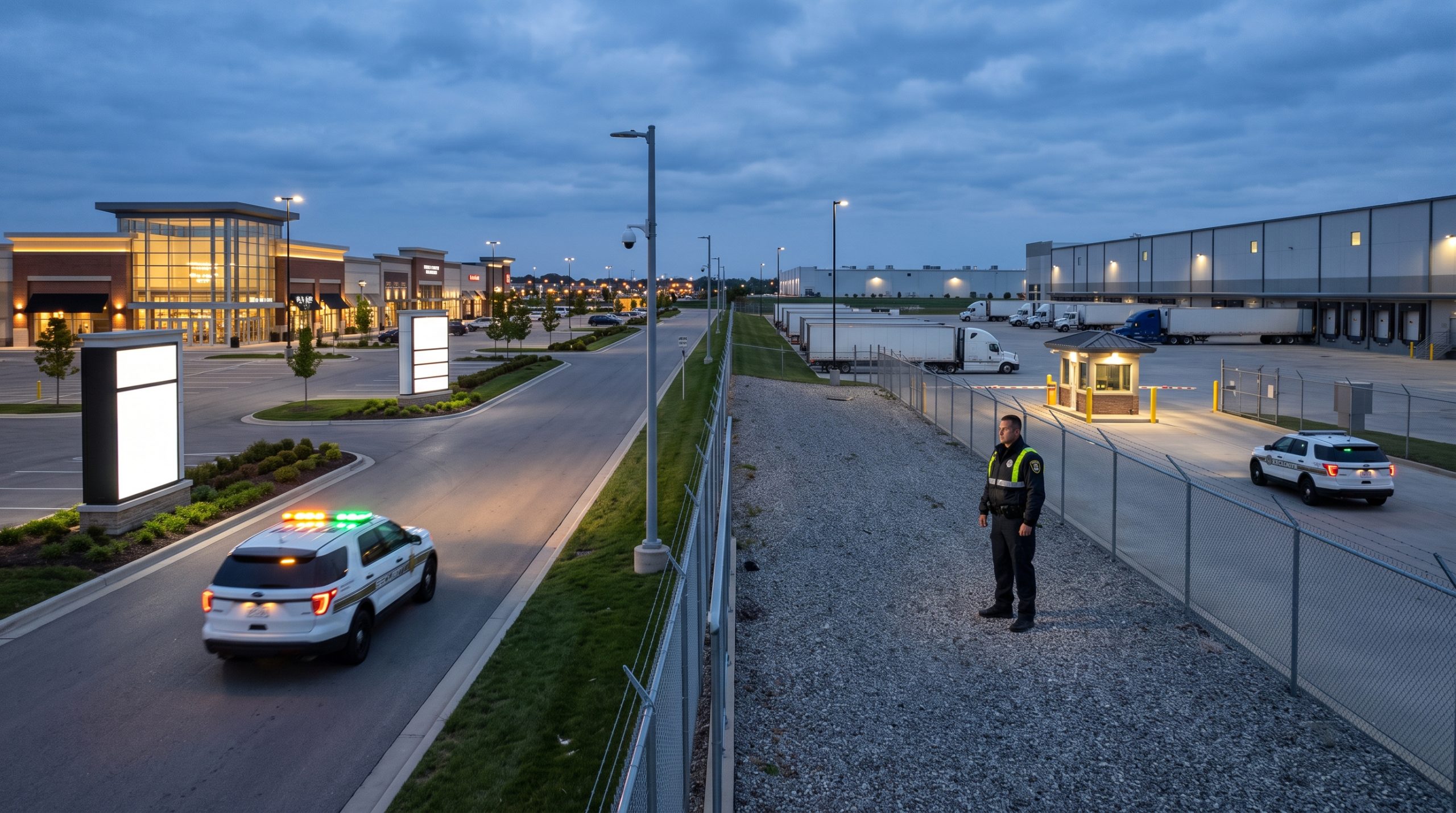
Armed vs. Unarmed Security: Commercial Risk & Cost Guide
Commercial property managers and asset directors face a constant dilemma: balancing physical site safety against property and casualty (P&C) insurance realities.
Deploying armed guards at a retail center can deter smash-and-grab theft. However, it also triggers firearms liability exclusions, increases excess liability premiums, and creates joint-employer risk.
On the other hand, funding a 168-hour standing guard post at an industrial park often leads to guard fatigue, high billing rates, and poor perimeter security.
Managing security requires calculating the Risk-to-Insurance Ratio. This ratio balances physical deterrence costs against commercial general liability (CGL) premiums, self-insured retentions (SIRs), and negligent security exposure.
1. Armed vs. Unarmed Security Guard Liability: Underwriting Realities
Many property owners believe armed guards provide total protection that reassures insurers. In commercial liability markets, underwriters view firearms as catastrophic loss multipliers rather than simple deterrents.
                 DETERRENCE & LIABILITY EQUILIBRIUM
                                ▲
                                │   [Catastrophic Exposure Zone]
                                │   * Wrongful Death / Weapon Discharge
             LIABILITY RISK     │   * Nuclear Verdicts ($10M+)
               & SURPLUS        │   * Firearms Exclusions
             LINES PREMIUM      │         ▲
                                │        /
                                │       /  ARMED POST
                                │      /
                                │     /   HYBRID PATROL
                                │    /
                                │   /   UNARMED STANDING
                                │  /
                                ┼──────────────────────────────►
                                   INCIDENT SEVERITY PROFILE
The Insurance Underwriting Gap: CGL vs. Surplus Lines
Unarmed security vendor contracts usually fall under standard Commercial General Liability (CGL) policies. Primary and umbrella policies readily cover bodily injury and property damage limits.
Switching to armed security changes this framework. Standard carriers frequently decline coverage or issue mandatory Assault & Battery (A&B) and Firearms Exclusions.
Key liability shifts include:
- Surplus Lines Placement: Property owners often require non-admitted surplus-lines policies to secure actual third-party bodily injury and firearms coverage.
- Higher Self-Insured Retentions (SIR): Armed contracts push deductibles into high-dollar retention tiers. A per-occurrence SIR can jump from $25,000 to $250,000 or $500,000 before insurance defense spending begins.
- Vicarious Liability Exposure: Plaintiff attorneys frequently name landlords alongside security contractors under negligent hiring and joint-employer doctrines. When an officer fires a weapon in a crowded parking lot, jury awards can trigger $10M+ nuclear verdicts. These verdicts quickly exceed vendor policy limits and target the owner’s umbrella policy.
When Does Unarmed Security Expose You to Negligent Security Claims?
Avoiding armed personnel does not eliminate liability.
Under premises liability common law and Restatement (Second) of Torts § 344, property owners must protect invitees from reasonably foreseeable third-party crimes.
If an asset has a documented history of violent crime, robbery, or carjackings, relying solely on unarmed guards limited to “observe and report” protocols can lead to negligent security lawsuits following an incident.
Property teams must weigh the likelihood of violent crime against the financial exposure of armed personnel.
2. Mobile Patrol vs. Dedicated Security Officer Cost: The 168-Hour Myth
Many property teams default to 24/7 standing guards. However, the economics of a 168-hour standing post (24 hours a day, 7 days a week) reveal significant operational waste compared to scheduled mobile patrols.
The Real Cost of a 168-Hour Dedicated Guard Post
Covering a continuous 168-hour post requires roughly 4.2 full-time equivalent (FTE) officers to prevent overtime penalties:
- Dedicated Unarmed Officer ($25–$35/hr billing rate):
$$\text{168 hrs/week} \times \$30/\text{hr (blended average)} \times 52 \text{ weeks} = \mathbf{\$262,080 / \text{year}}$$ - Dedicated Armed Officer ($38–$55/hr billing rate):
$$\text{168 hrs/week} \times \$46/\text{hr (blended average)} \times 52 \text{ weeks} = \mathbf{\$401,856 / \text{year}}$$
               ANNUAL SECURITY EXPENDITURE COMPARISON
  ┌──────────────────────────────────────────────────────────────┐
  │ 168-Hr Dedicated Armed Post                     $401,856/yr  │
  ├──────────────────────────────────────────────────────────────┤
  │ 168-Hr Dedicated Unarmed Post                   $262,080/yr  │
  ├──────────────────────────────────────────────────────────────┤
  │ Hybrid Model (Peak Standing + Off-Peak Patrol)   $98,280/yr  │
  ├──────────────────────────────────────────────────────────────┤
  │ Tier-1 Mobile Vehicle Patrol (4 hits/night)      $58,400/yr  │
  └──────────────────────────────────────────────────────────────┘
  $0          $100k         $200k         $300k         $400k
Mobile Vehicle Patrol Unit Economics
Mobile patrol vendors bill per property inspection or on a flat monthly retainer rather than by the hour:
- Metropolitan Market Rates: Marked patrol vehicles equipped with amber/green roof lights, dashcams, and GPS tracking cost $35 to $55 per property hit.
- Standard Off-Peak Schedule: Four randomized visits per night (20:00 to 06:00), 365 nights per year:
$$4 \text{ visits} \times \$40/\text{visit} \times 365 \text{ days} = \mathbf{\$58,400 / \text{year}}$$
Net Savings: Replacing a 24/7 dedicated unarmed post with mobile patrol recovers $203,680 in net operating income (NOI) per property every year. Meanwhile, digital GPS systems continue logging perimeter checks, door seals, and exterior gates.
Mobile Patrol vs. Standing Guard Performance
Mobile patrol provides clear operational advantages for large commercial footprints:
- Broader Coverage: Walking officers cover 2 to 3 miles per hour. A patrol vehicle covers 40-acre logistics yards, lights up dark fence lines, and checks loading docks within minutes.
- Disrupting Criminal Reconnaissance: Fixed guards often fall into predictable patterns or face overnight fatigue in guard shacks. Randomized vehicle patrols arrive at unpredictable times, making it difficult for trespassers to time their entries.
- When Dedicated Posts Remain Essential: Mobile patrol cannot replace fixed access points. Dedicated standing guards are required when properties need constant bill-of-lading (BOL) verification, real-time visitor badging, or ongoing active lobby management.
3. Property Profile Matrix: Retail Centers vs. Industrial Parks
Sprawling industrial distribution parks require an entirely different security strategy than open-air retail centers or lifestyle malls.
| Security Model | Best Commercial Applications | Liability Profile & Insurance Impact | Annual Cost Range (Per Site) | Key Operational Trade-offs |
| Dedicated Unarmed Officer | • Retail indoor concourses • Commercial office lobbies • Active industrial gatehouses | Standard CGL limits apply; low underwriting friction; low-to-medium baseline slip-and-fall exposure. | $218,000 – $305,000 (168-hr post basis) | High annual cost on large acreage; susceptible to guard fatigue on graveyard shifts. |
| Dedicated Armed Officer | • High-value retail (luxury jewelers) • Precious cargo transit hubs • High-crime logistics terminals | Strict surplus lines rules; mandatory firearms and A&B endorsements; $100k+ SIRs; joint-employer exposure. | $332,000 – $480,000 (168-hr post basis) | Bystander casualty risks in dense retail centers; negative customer experience. |
| Mobile Vehicle Patrol | • Distribution centers (overnight) • Truck yards & storage lots • Retail strip plazas (overnight) | Low operational liability; minimal direct interaction with public; requires commercial auto policy riders. | $35,000 – $75,000 (3 to 5 visits/night) | No continuous on-site presence; relies on remote cameras for inter-patrol detection. |
| Hybrid Deployment (Tactical Allocation) | • Regional shopping centers • Mixed-use industrial parks • Power retail centers | Balanced risk profile; unarmed personal engagement during the day; mobile deterrence at night. | $85,000 – $145,000 (Day guard + Night patrol) | Requires strict operational coordination between day shift guards and night mobile patrol vendors. |
4. The Hybrid Framework: Tactical Deployment by Threat Tier
Optimizing physical security does not require an all-or-nothing investment. Commercial operators use tiered schedules based on traffic volume, peak crime windows, and property layouts:
               HYBRID OPERATIONAL POSTURE SCHEDULE
┌────────────────────────┬──────────────────────────┬────────────────────────┐
│   DAY SHIFT (08:00-18:00)│ DUSK/EVENING (18:00-22:00)│ OVERNIGHT (22:00-06:00) │
├────────────────────────┼──────────────────────────┼────────────────────────┤
│ Dedicated Unarmed      │ Standing Concierge Guard │ High-Frequency Mobile  │
│ Concierge / Access     │ + Visible Parking Escort │ Patrol (Randomized     │
│ Control Officer        │ (Deterring Carjackings)  │ 45-Min Checks & Scans) │
└────────────────────────┴──────────────────────────┴────────────────────────┘
Retail Plazas & Lifestyle Centers
- Business Hours (08:00 – 21:00): Staff Unarmed Standing Security. Keep the focus on customer support, access control, and verbal de-escalation. Armed guards in standard retail settings often make shoppers uncomfortable and raise liability risks without improving theft deterrence.
- Dusk Window (17:00 – 22:00): Add a marked patrol vehicle with overhead lights to monitor surface lots. This discourages vehicle break-ins, loitering, and robbery during closing shifts without placing weapons inside tenant spaces.
- Overnight Hours (22:00 – 06:00): Use Dedicated Mobile Patrol (3 to 5 visits nightly). The patrol unit clears alleyways, checks padlocks, and monitors empty parking areas, eliminating the expense of a continuous overnight guard.
Industrial Logistics & Distribution Parks
- Shift Changes & Freight Check-In: Use a Dedicated Unarmed Gate Officer to log bills of lading, register carrier credentials, and manage truck traffic.
- Yard Security & Perimeter Defense: Avoid paying for armed guards to patrol remote fence lines. Instead, combine Off-Peak Mobile Patrol with Remote Video Monitoring (RVM):
- Deploy solar-powered AI thermal cameras with two-way voice speakers along vulnerable property lines.
- When trespassers cross the perimeter, monitoring center operators issue an immediate live verbal warning over the loudspeakers.
- If intruders do not leave, the control center dispatches the on-contract patrol vehicle and requests prioritized police response.
This combination stops perimeter incursions for a fraction of the cost of a 168-hour standing guard post, all while avoiding lethal-force risks.
5. Contractual Risk Transfer & Indemnification Standards
Even an optimized security deployment will fail if your vendor contract exposes your balance sheet. Ensure every security Master Services Agreement (MSA) includes these basic protections:
1. Broad-Form Indemnification with Immediate Defense Obligations
Never sign vendor contracts that restrict indemnity to “gross negligence” or “willful misconduct.” Require standard broad-form indemnity clauses that require the vendor to defend, indemnify, and hold harmless the property owner from all claims, lawsuits, and defense costs arising from their work, including ordinary negligence.
2. Primary & Non-Contributory Additional Insured Endorsements
Require Additional Insured status using ISO forms CG 20 10 (ongoing operations) and CG 20 37 (completed operations), or identical carrier endorsements. The policy must state that the security contractor’s insurance is primary and non-contributory. The contractor’s policy must pay out first before your commercial property or umbrella coverage responds.
3. Waiver of Subrogation
Require explicit Waivers of Subrogation across General Liability, Commercial Auto, and Workers’ Compensation policies. If an officer gets injured on your property, this waiver bars their workers’ comp insurer from suing the property owner to recover benefits.
4. Review Crucial Policy Endorsements
Inspect the security vendor’s actual policy endorsements, not just their ACORD Certificate of Insurance:
- Assault & Battery (A&B) Coverage: Confirm A&B coverage is intact and not sub-limited to inadequate amounts (such as $25,000 or $50,000).
- Firearms Coverage: For armed posts, verify the policy does not contain a standard firearms exclusion endorsement.
- Care, Custody, & Control (CCC) / Lost Key: Make sure your mobile patrol vendor carries lost-key and rekeying coverage to protect against lost master keys or access cards.
Action Plan: Real Estate Portfolio Security Audit
Execute these four operational steps to align your properties with an optimal risk-to-insurance profile:
- Audit Post-by-Post Spend: Pull general ledgers to identify all properties utilizing 168-hour standing guard contracts. Compare these expenses with gate access logs to determine whether overnight posts can shift to mobile patrols.
- Review COIs and Endorsements: Collect current vendor COIs and policy forms. Check that armed posts carry verified firearms riders and that your policies do not carry unvetted A&B exclusions.
- Conduct CPTED Site Assessments: Upgrade exterior LED lighting, clear line-of-sight landscaping, and secure perimeter gates. Improving basic physical security lets you transition properties from armed details to unarmed mobile patrols safely.
- Shift to Hybrid Contracts: Restructure vendor scopes of work. Replace expensive overnight standing posts with GPS-verified mobile patrol checks linked to automated perimeter camera systems.
Related Posts
Trending News
Where robots are reshaping US jobs today.
By Leila Monroe
September 22, 2025
Safety
Introduction: Hospitals Must Heal, But They Must Also Protect Hospitals are built for healing, but the modern healthcare environment is becoming one of the most unpredictable workplaces in America. Every day, nurses, physicians, receptionists, behavioral health teams, security officers, and support staff step into environments where emotions are high, wait times are long, families are […]
By Leila Monroe
July 1, 2026
Cyber Security
From stopping cyberattacks before they happen to creating hyper-realistic deepfakes, artificial intelligence is reshaping the world of security. This article explores the dual nature of AI, examining its powerful role as a guardian while uncovering the emerging threats it poses to corporations, governments, and individuals.
By Anonymous + Gemini
August 9, 2025