




Retail Security: How Stores Cut Theft Without Hurting the Customer Experience
Retailers need to stop theft and protect staff without turning stores into fortresses. This guide covers guard models, costs, armed vs. unarmed, use-of-force policy, and a 7-point checklist for vetting any security company.
By David Kerolles
October 5, 2026
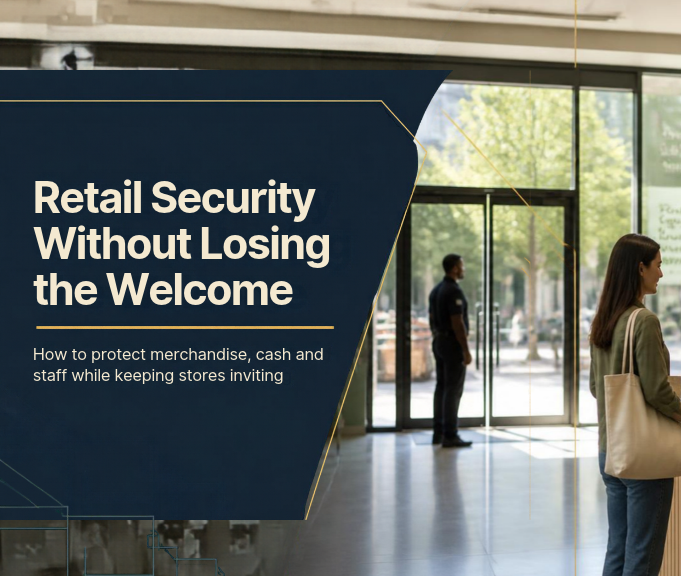
Retailers must protect merchandise, cash and staff, but they must also keep stores welcoming enough that customers want to walk in, browse and buy. Lean too far one way and you bleed inventory. Lean too far the other and you build a store people avoid.
This guide is for store operators, property managers and loss prevention leads deciding whether to hire security, what kind, and how to tell a reliable vendor from a risky one. It covers where retail losses actually happen, how the main guard models compare, what armed coverage does to your insurance picture, and a seven-point checklist for vetting any security company before you sign.
The retail risk picture
- Shrink is large and still climbing. The National Retail Federation (NRF) reported retail shrink of $112.1 billion in fiscal 2022, up from $93.9 billion the year before, with the average shrink rate rising from 1.4% to 1.6%.
- Outsiders drive most of it. Retailers attributed the largest share of shrink to shoplifting, burglary, robbery and other crimes by non-employees.
- Violence is the sharper worry. In NRF’s 2023 survey, 67% of retailers said aggression and violence tied to organized retail crime had increased over the prior year. A later NRF report cited a 93% rise in average shoplifting incidents since 2019 and a 17% increase in threats or acts of violence during theft events.
- Few employees can step in. 41% of retailers said no employees are authorized to stop or apprehend shoplifters, and 54% were increasing workplace violence training.
- A caveat on the data. Retail crime is hard to measure, and NRF has revised earlier claims about how much shrink comes from organized crime. Treat headline figures as directional and track your own store-level numbers.
The takeaway: the threat is shifting from quiet inventory loss toward confrontation, and that changes what you need from a guard. A guard who only stands at the door is no longer enough. A guard who confronts every suspect is a liability.
Where retail losses actually happen
Walk your own store against this list before you talk to any vendor:
- Entrances and exits: the first and last chance to deter or observe.
- High-resale categories: health and beauty, electronics, baby products, alcohol, razors, over-the-counter medicine and other small, easy-to-resell items.
- Fitting rooms and blind aisles: low visibility, low supervision.
- Returns desk: return fraud is a growing form of retail crime.
- Receiving docks and stockrooms: internal and external theft.
- Parking lot: vehicle break-ins, loitering, and robberies of customers and staff.
- Cash office and registers: robbery risk and cash-handling exposure.
- Opening and closing: staffing is thinnest and risk is highest.
Mark each one high, medium or low for your store. That map, not a generic quote, should drive your scope of work.
The customer experience tension
A guard’s posture matters as much as headcount. Many loss prevention teams use a visible, friendly presence (greeting, walking the floor, making eye contact) to signal attention without confrontation. A heavy enforcement posture can chill sales, intimidate shoppers and invite escalation.
Decide in advance which job the guard is hired to do:
- Deterrence: be visible, greet, observe.
- Response: de-escalate, call police, protect staff and customers.
- Enforcement: detain suspects, which carries the most legal and safety risk.
Most retail sites are best served by deterrence plus response. Enforcement should be a deliberate, written decision, not a default.
Guard models compared
| Model | Best for | Customer-experience impact | Typical cost | Watch-outs |
|---|---|---|---|---|
| Unarmed uniformed (door or floor) | Most storefronts, strip centers, grocery | Low if trained for service; visible deterrent | Roughly $20–$40/hr | Not authorized or trained to detain; coverage gaps during breaks |
| Armed uniformed | Jewelry, electronics, cash-heavy or high-crime sites, late hours | Can feel heavy-handed | Roughly $40–$75/hr | Higher insurance cost, firearms liability, stricter licensing |
| Plainclothes loss prevention | Repeat-theft stores, high-value zones | Nearly invisible to shoppers | Quote-based, often above unarmed | Needs a strong detention policy and training |
| Mobile patrol | Parking lots, after-hours, multi-site centers | None inside the store | Quote-based, often per visit | Periodic response, not continuous |
| Remote video monitoring | Closed hours, low-traffic sites, supplement to guards | None | Quote-based, often a monthly fee | Needs a live dispatch path; verify response times |
| Hybrid | Sites with several risk types | Balanced | Varies | Needs one coordinating contract |
Rates vary widely by city, shift, contract length and risk level. Get at least three quotes and compare the scope, not just the hourly rate.
Armed or unarmed?
For most retail, unarmed is the right default. Visible, well-trained unarmed officers deter most opportunistic theft and avoid the cost and liability that come with firearms.
Consider armed coverage when the site has:
- High-value, easily fenced goods (jewelry, electronics)
- Significant cash on hand or cash handling
- A documented history of armed robbery or violent incidents
- Late-night or isolated operating hours in a high-crime area
Armed posts raise premiums, add licensing and qualification requirements, and increase the stakes of any use-of-force incident. Before choosing, run the numbers using our armed vs. unarmed risk-to-insurance matrix.
Use of force, detention and the “observe and report” rule
This is where most retail security disputes start. Settle it in writing before the first shift.
- Get the vendor’s written policy and align it with your own store policy. If they conflict, resolve it before signing.
- Default to observe and report. Many retailers do not authorize anyone to chase or detain suspects because it is dangerous for staff, guards and bystanders.
- Know your state’s rules. Merchant detention laws differ by state, and the standards for reasonable detention vary. Have counsel confirm what your guards may and may not do.
- No pursuit off property unless the policy explicitly allows it.
- Require documentation: incident reports, photos or video, witness names, and a time limit for submitting them.
- Cameras and recording: if guards use body-worn cameras, confirm they are legal in your state and consistent with customer privacy.
Insurance and liability
Retail is a premises liability environment. If a customer or employee is injured and the security arrangement looks negligent, the store, the property owner and the guard company can all be pulled in.
What to confirm with any vendor:
- Commercial general liability limits that fit your risk, with you named as an additional insured
- Assault and battery coverage that is actually in the policy, not excluded or heavily sublimited
- Workers’ compensation coverage for guards, so injuries do not become your claim
- Whether guards are employees or independent contractors (see the protocol below)
Ask your own broker how the vendor’s coverage interacts with your policy.
Licensing and compliance
Every state regulates security companies and officers differently, from operator licenses to guard registration, firearm permits and training hours. Use our 50-state security guard licensing and compliance matrix to check what applies where you operate, and verify licenses directly on the state board’s website.
The Guardist 7-Point Vetting Protocol, retail edition
Use this checklist with every vendor, and keep the documents on file.
| Step | Verification check | Source | Acceptance criteria |
|---|---|---|---|
| 1 | State operator licensing | State licensing board (for example, BSIS in California, NY Department of State) | Active operator license; no suspensions or revocations in the past 5 years; no unresolved labor-law violations |
| 2 | Insurance endorsements | Certificate of insurance direct from the carrier, plus the actual endorsement forms and 3–5 years of loss runs | CGL limits that fit your risk (commonly $1M per occurrence and $2M aggregate with umbrella, higher for high-value or high-risk stores); you named as additional insured; primary and non-contributory wording; waiver of subrogation |
| 3 | Assault and battery coverage | Policy declarations page | Explicitly covered; no total exclusion; sublimits disclosed; no firearms exclusion on armed posts |
| 4 | Guard certification audit | Roster, guard cards and the state registry | 100% of assigned officers hold active state licenses matching the roster; employee vs. contractor status disclosed; subcontractors named; armed officers show firearm permit and qualification |
| 5 | Proof-of-service systems | Live demonstration of the vendor’s reporting tools | Verified patrol tracking, incident reporting with photo capability, and real-time supervisor dispatch, on any platform; small agencies may use paper logs with an audit trail; you can export your data |
| 6 | Retail SOP curriculum | Post orders and training records | Retail-specific post orders plus dated training records for de-escalation, use of force, shoplifting observe-and-report, and customer service |
| 7 | Emergency response SLA | Master services agreement | Guards call 911 first; supervisor contact within 15 minutes; supervisor on site within 30–60 minutes for critical incidents; no-show coverage within 2 hours |
Retail overlay (required in addition to the seven steps):
- A written use-of-force and detention policy that matches yours
- Customer-facing conduct standards, including how officers greet, approach and speak to shoppers
- A defined handoff with your store loss prevention or management team
Coverage numbers here are common baselines, not advice. Have your insurance broker confirm what fits your exposure.
Questions to ask in the RFP
- Who is on the roster for my site, and are they employees or subcontractors?
- What training do officers receive specifically for retail?
- What is your written policy on detention and pursuit?
- How do you handle breaks, call-outs and no-shows?
- What are your response times for supervisors, and how are they documented?
- Can I see sample incident reports and the platform you use?
- What is your claims history over the last five years?
- What happens after a use-of-force incident, step by step?
- How do you measure performance for retail clients, and what do you report to me?
- What is your officer turnover rate, and how do you keep continuity at a site?
Matching coverage to store type
- Big-box and department stores: a mix of uniformed door presence, plainclothes loss prevention in high-theft zones, and mobile patrol for the lot.
- Grocery and convenience: a visible unarmed presence at peak hours, with remote monitoring or mobile patrol overnight.
- Strip centers and shopping plazas: shared mobile patrol and parking lot coverage, with per-tenant add-ons as needed.
- Jewelry and high-value retail: armed or highly trained officers, strict access control and cash-handling procedures.
- Boutiques and small shops: often camera-led, with occasional guards for peak hours and closing.
Measure what matters
Track these monthly and review them with your vendor:
- Shrink rate and incident counts, by location and time of day
- Incident response times and report turnaround
- Customer complaints involving security
- Officer turnover and no-show rate
- Cost per incident prevented or resolved
If the numbers do not improve in 60 to 90 days, change the scope, the site orders or the vendor.
Find verified retail security vendors
Ready to compare options? Browse verified security vendors on Guardist, filter by service and location, and request quotes side by side.
Editor’s note: Guardist is part of The City Guards, which also makes workforce management software for security agencies. This guide is vendor-neutral and the vetting protocol applies to any security company.
Related Posts
Security Guards
I really enjoy doing dead-end work for my unhelpful bosses, making no real money at it, and never getting ahead…” Said no one ever. You are someone that has long dreamed of running your own security guard company. You know you can do security work better than what you’ve seen out there- doing things your […]
By David
March 30, 2025
Trending News
Balancing physical access control with an inviting residential experience requires a data-driven security strategy. This operational guide breaks down premises liability and the legal foreseeability standard, Fair Housing Act anti-profiling risks, coverage model cost comparisons, and the mandatory 7-point vendor vetting protocol to protect multifamily assets and resident communities.
By Michael Y. Daniels
October 5, 2026
Trending News
Where robots are reshaping US jobs today.
By Leila Monroe
September 22, 2025