





The Hacker in Your Head: Why We Trust When We Shouldn’t
Think back to the last time you bought something you didn’t really need, or agreed to something you later regretted. Chances are, it wasn’t because someone held a gun to your head. It was because someone played a trick on your brain. They made you feel rushed, important, or just plain helpful. This isn’t just […]
By Anonymous + Gemini
December 18, 2025
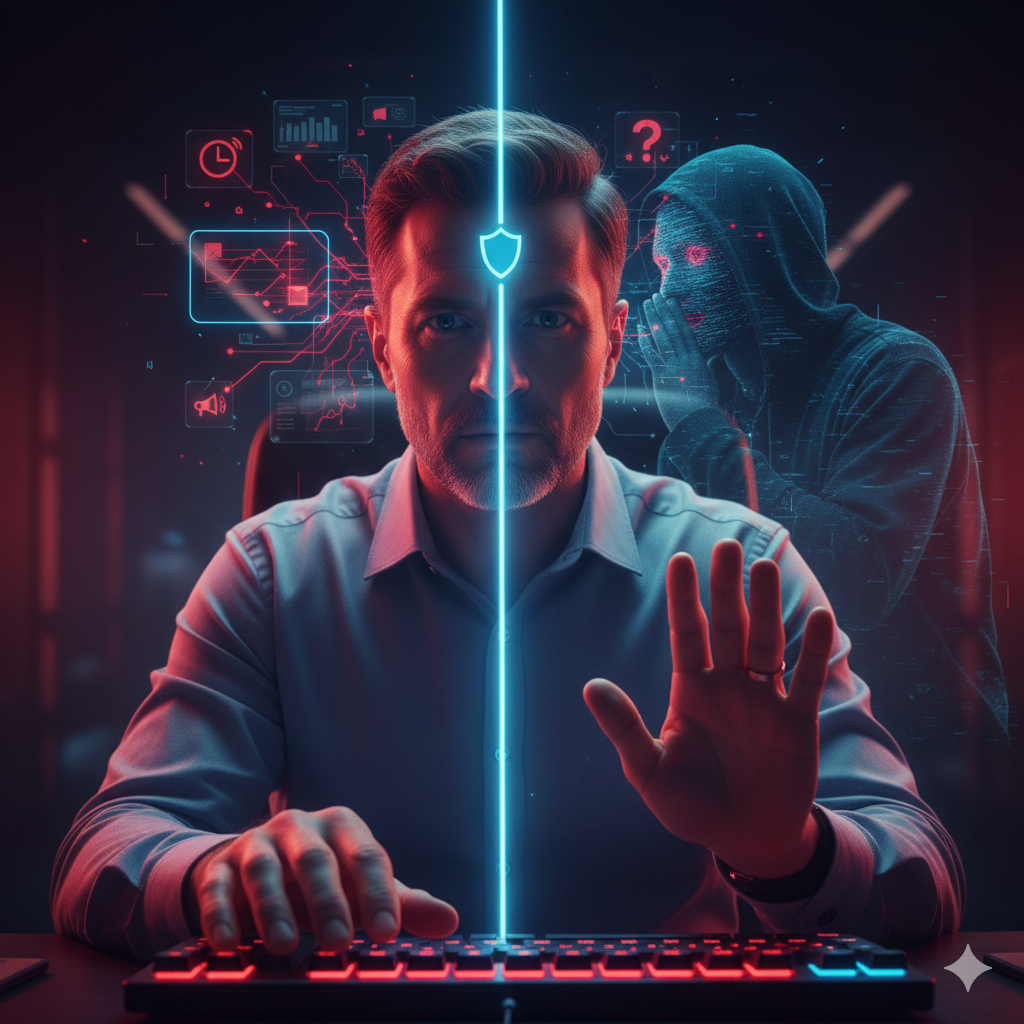
Think back to the last time you bought something you didn’t really need, or agreed to something you later regretted. Chances are, it wasn’t because someone held a gun to your head. It was because someone played a trick on your brain. They made you feel rushed, important, or just plain helpful.
This isn’t just about sales; it’s the core of almost every successful cyberattack or physical breach today. Forget complex code or high-tech gadgets for a moment. The most dangerous weapon in a scammer’s toolkit isn’t a virus; it’s a deep understanding of how you think. They are not hacking computers; they are hacking you.
The Brain’s “Easy Button”: Our Natural Tendency to Trust
As humans, we’re wired for connection and cooperation. This is a good thing – it’s how societies are built. But it also means our brains have an “easy button” that scammers love to exploit: our default to trust. We naturally assume people are telling the truth. We assume the email from “IT Support” is real. We assume the person in a uniform is authorized. This fundamental human trait, while essential for daily life, is precisely what makes us vulnerable.
Scammers, social engineers, and con artists are masters of manipulating these natural instincts. They don’t rely on brute force; they rely on psychological pressure points. They use a few key tricks, over and over again, because they work:
Trick #1: The Power of “Now!” – The Urgency Trap
Imagine your phone rings. It’s a text message that says, “Your bank account has been locked. Click here immediately to verify.” Or an email from “HR” stating, “Urgent: Your health benefits expire tonight if you don’t update your information.” What’s your first reaction? A little jolt of panic, right?
This is the urgency trap. Scammers know that when you feel rushed, your brain switches from careful thinking to quick reacting. You don’t have time to check the sender’s email address, hover over a link, or call HR directly. You just react.
- How it feels: A knot in your stomach, a racing heartbeat, the feeling that you must act instantly.
- Why it works: Our brains are designed to respond to immediate threats. A fire, a car horn, an urgent message – these all trigger a “fight or flight” response, bypassing our logical, critical thinking.
- Physical Threat Example: A person in an office hallway yelling, “Fire alarm test! Everyone out, leave your bags!” in hopes that people will abandon their laptops and valuables in the rush to evacuate.
Trick #2: The Impersonation Game – The Authority Play
This is perhaps the oldest trick in the book. Someone pretends to be important. They might say they’re the CEO, a senior manager, an IT technician, or even law enforcement. They demand immediate action or sensitive information.
- How it feels: A sense of obligation, a fear of questioning someone “important,” or simply a desire to be helpful.
- Why it works: We are taught from a young age to respect authority. When someone appears to be in charge, our natural inclination is to follow instructions without question. This is amplified in a work environment where failing to comply with a superior’s request could have career consequences.
- Physical Threat Example: A person wearing a high-visibility vest or a fake uniform, carrying a clipboard, walking into a restricted area. “I’m with maintenance, here to check the wiring.” Most people won’t question someone who looks like they belong.
Trick #3: The “I Scratch Your Back…” – The Reciprocity Ploy
This one is subtler, but incredibly powerful. It plays on our desire to be fair and to repay favors. Sometimes, a scammer will do something small for you first, creating a tiny sense of obligation.
- How it feels: A subtle push to “return the favor,” a feeling that you owe them something.
- Why it works: It triggers our inherent desire to balance the scales. If someone gives us something, even a small piece of information or a compliment, we feel compelled to give something back.
- Example: A stranger holds the door for you, makes friendly small talk, and then asks for a quick favor like, “Could you just hold this door for a second? My badge isn’t working right now.” Because they were nice to you, you’re more likely to bend the rules.
Trick #4: The Lure of the Unknown – The Curiosity Bait
We are inherently curious creatures. If something promises a secret, gossip, or something new and exciting, we’re often drawn in.
- How it feels: An irresistible urge to click, to know more, to uncover a hidden detail.
- Why it works: Curiosity is a strong motivator. Scammers exploit this with subject lines like “Confidential Employee Bonus List” or “Shocking News About [Company Name].” These emails trigger our desire for insider information, often overriding our caution.
- Physical Threat Example: A USB stick labeled “Q4 Financial Projections – CONFIDENTIAL” left conspicuously in a public area. The hope is that someone’s curiosity will lead them to plug it in and see what’s on it.
Your Best Defense: The “Pause” Button in Your Brain
Recognizing these tricks is the first step. The second, and most important, is learning to hit your brain’s “pause” button. This is your personal Human Firewall.
When you feel any of these emotions, panic, obligation, or intense curiosity, that should be your internal alarm bell.
Here’s your “Pause Protocol”:
- Stop: Don’t click. Don’t reply. Don’t open the door. Just stop whatever you’re doing.
- Breathe: Take a deep breath. This helps slow down your emotional response and lets your logical brain catch up.
- Think:
- Is this normal? Does my boss usually ask for urgent wire transfers via text? Does IT ever ask for my password via email?
- Who benefits? Am I truly benefiting, or is someone else?
- Can I verify? Can I call the sender back on a known number (not the one from the suspicious message)? Can I physically walk to their office?
- What if I do nothing? If it’s a legitimate request, it can wait five minutes for you to verify. If it’s a scam, a five-minute delay stops the attack.
- Report: If something feels off, report it to your security team or manager. Every “near miss” you report helps everyone else.
Beyond the Screen: Professionalizing the Response
This human element also extends to your professional security team. Your guards are the front line of defense against these social engineering tactics in the physical world. Are they trained to question a confident, clipboard-wielding stranger? Do they know how to handle a situation where someone demands entry based on “urgent authority” without proper ID?
For these critical roles, organization and training are paramount. Tools that help manage and coordinate these efforts, such as security guard and scheduling software, become vital. By using platforms like thecityguards.com, you ensure your guards are properly briefed, in position, and have clear protocols for these psychological attacks, turning a potential weak point into a robust defense.
Conclusion: Trust Your Gut, But Verify
The scammers are getting smarter, but they’re still playing the same old psychological games. By understanding how they try to manipulate your basic human instincts, your helpfulness, your respect for authority, your fear of missing out, you gain the ultimate defense.
Your brain is not a weakness; it’s your most powerful security tool. You just need to know how to use it.
Related Posts
Cyber Security
AI-powered voice scams are targeting families by mimicking the voices of loved ones. Discover how these “deepfake” calls work, how to defend against them with a simple safeword system, and where to report if you’ve been targeted.
By Michael Y. Daniels
July 14, 2025
Safety
Public-Private Collaboration for Scalable Security As our cities grow and change, so do the challenges of keeping them safe. It’s no longer just about having more police or fences—people want to live in communities that feel secure, supportive, and built with families in mind. Most of all, we owe it to our children to create […]
By David Kerolles
July 1, 2025
Safety
We’ve all seen the movies where a master of disguise puts on a realistic mask to sneak into a vault. It used to be science fiction. But today, that “mask” is digital, it’s incredibly easy to make, and it’s being used to target people just like you every single day. It’s called a Deepfake. Using […]
By Michael Y. Daniels
December 18, 2025