



Private Security vs Police: Why Security Guards Now Outnumber Police in 2026
The debate around private security vs police is no longer just a theory. In 2026, it has become a real and important issue across the United States and many other parts of the world. For years, most people assumed police were the main visible force responsible for safety in public life. That is no longer […]
By David Kerolles
April 12, 2026
The debate around private security vs police is no longer just a theory. In 2026, it has become a real and important issue across the United States and many other parts of the world.
For years, most people assumed police were the main visible force responsible for safety in public life. That is no longer always true. Today, private security guards are everywhere. They protect office buildings, residential communities, retail centers, hospitals, schools, events, transit locations, and public-facing properties. In many places, they are now more visible than police officers.
That is why the topic of private security vs police matters more than ever. This is no longer just about numbers. It is about how safety is changing, who is providing it, and what that means for businesses, communities, and the future of public protection.
Private Security vs Police in 2026
When people search for private security vs police, they often want to know one main thing: who has the larger role today?
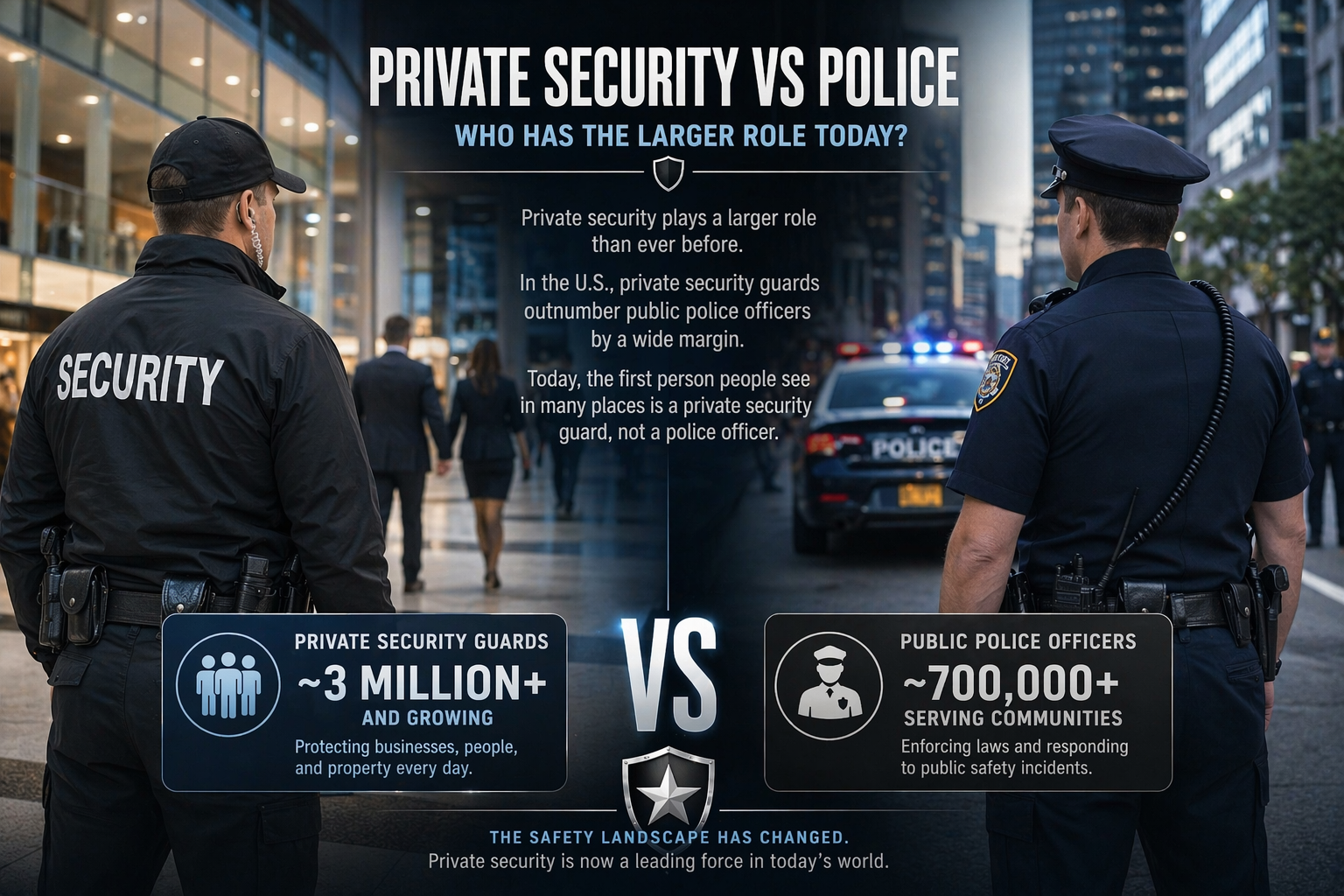
The answer is clear. Private security is now playing a much larger role than it did in the past. In the United States, private security guards now outnumber public police officers by a wide margin. That means the safety system people experience every day is no longer shaped only by government law enforcement. It is increasingly shaped by private companies, private contracts, and private security teams.
This shift is changing how people think about protection. In many environments, the first person a visitor, employee, tenant, shopper, or resident sees is not a police officer. It is a private security guard.
Why Private Security vs Police Is a Growing Debate
The reason the private security vs police debate is growing is simple: demand for visible security is rising, while public systems are under pressure.
Police departments in many areas continue to face staffing shortages, slower recruiting, and retention problems. At the same time, businesses, property managers, schools, hospitals, and cities still need visible protection. They want people on-site who can watch activity, manage entrances, report incidents, deter misconduct, and respond quickly when issues happen.
Private security fills that gap.
It is often faster to hire a private security company than to expand a public police force. It is also often more flexible. A private company can assign guards to a specific property, schedule, risk level, or event need. That makes private security attractive to organizations that want direct control over their protection strategy.
So when people compare private security vs police, the discussion is no longer only about power or authority. It is also about speed, flexibility, cost, and availability.
Private Security vs Police: The Key Difference
It is important to understand that private security vs police does not mean the two are the same.
Police officers hold public authority. They enforce criminal laws, investigate crimes, and operate under legal powers granted by the state. Private security guards usually do not have that same level of authority. Their main role is to observe, deter, control access, report incidents, and protect people or property within the limits of their assignment.
That is a major difference.
However, while police and private guards are not the same, the line between them is becoming more important in daily life. Private security may not replace police in a legal sense, but it is clearly taking on a much larger role in the visible side of protection.
That is why the private security vs police comparison has become such a strong topic. It reflects a real shift in how safety is being delivered.
Why Private Security Is Growing Faster Than Police
One of the biggest reasons private security is growing is simple economics.
Private security is often more affordable for businesses and organizations than relying only on public response. It can also be deployed more quickly and tailored more precisely to a site’s needs. A shopping center may need evening patrols. A hospital may need access control. A residential community may want overnight patrol checks. A construction site may need temporary guard coverage. Private security can meet those needs directly.
Another reason is the rising need for visible presence. Many property owners do not want to wait until a crime happens. They want prevention, deterrence, monitoring, and documentation before situations escalate.
This is where the private security vs police conversation becomes practical. Police are still essential, but many organizations now see private security as the day-to-day layer that helps reduce risk, support order, and improve response readiness.
What Changed in 2025
In 2025, the conversation around private security vs police became more serious.
Older articles often focused only on the headline that private security outnumbers police. Newer articles started asking deeper questions. Why is private security growing so fast? Why are cities, transit systems, and businesses depending on it more? What happens when visible safety becomes more privately managed?
That change matters.
In 2025, more writers and researchers began treating private security as a structural part of the modern safety system, not just a support service. The focus shifted from surprise to explanation. Instead of saying, “This is interesting,” the newer articles asked, “Why is this happening, and what does it mean?”
That made the private security vs police discussion much more relevant for search engines, business readers, city leaders, and the general public.
What Changed in 2026
In 2026, the private security vs police discussion expanded even further.
The issue became bigger than headcount. It moved into questions of surveillance, privacy, accountability, and technology.
Modern private security is no longer limited to guards on foot or stationed at entrances. It now includes cameras, remote monitoring, access systems, AI-supported surveillance, mobile patrols, reporting software, and integrated safety networks. This means private security is becoming more powerful, more data-driven, and more embedded in daily life.
That changes the conversation.
The topic of private security vs police is now also about who controls security information, who manages surveillance systems, and who is accountable when private protection becomes a major public-facing force.
Is Private Security Replacing Police?
This is one of the most common questions in the private security vs police debate.
The short answer is no, not fully.
Private security is not replacing police in terms of formal government authority. Police still have a legal role that private guards generally do not. But private security is taking on a bigger share of the visible, everyday work of protection.
That means more people are interacting with private guards in the places where they live, shop, work, travel, and gather.
So while private security is not replacing police completely, it is absolutely becoming a larger part of the protection system. That is why the phrase private security vs police now matters so much. It captures a change that people can see in real life.
The Risk Behind Private Security vs Police
The biggest concern in the private security vs police debate is not only growth. It is inequality.
As private security becomes more common, protection can become easier to buy. Communities and organizations with more money can hire more guards, install better systems, and create stronger visible protection. Others may still depend on limited public resources alone.
That can create a two-tier safety environment.
This is one of the most important reasons the issue deserves attention. The growth of private security may help meet real needs, but it also raises serious questions. Will safety become more uneven? Will accountability stay clear? Will private systems gain influence faster than regulations evolve?
These questions make the private security vs police topic more than a simple comparison. It is a long-term question about fairness, safety, and public trust.
What Businesses Should Learn From Private Security vs Police
For businesses and property owners, the private security vs police conversation is highly practical.
It shows that security planning can no longer depend on a single layer. Many organizations now need a more active and more structured protection strategy. That may include on-site guards, patrol services, monitoring, incident reporting, visitor management, and stronger coordination with public agencies when needed.
The lesson is not that police are less important. The lesson is that private security now plays a much larger role in prevention and day-to-day operations.
Businesses that understand this shift can make smarter decisions about risk management, staffing, site protection, and response planning.
What Cities and Communities Should Consider
Cities and communities also need to take the private security vs police trend seriously.
As private security grows, oversight becomes more important. Licensing, training, reporting standards, use-of-force rules, privacy protections, and technology limits all need clear attention. Growth without standards can create confusion, trust problems, and inconsistent outcomes.
If private security is going to remain a major part of the safety landscape, then communities need clear expectations around quality and accountability.
That is why the private security vs police issue is not only a business matter. It is also a policy and governance issue.
Final Thoughts on Private Security vs Police
The phrase private security vs police may sound like a simple comparison, but it represents a much bigger shift.
Private security is no longer operating only in the background. It is now one of the most visible and active layers of modern protection. In many places, people encounter private guards more often than they encounter police officers.
That does not mean police no longer matter. They do. But it does mean the structure of safety is changing.
The real question is not just who is bigger. The real question is how this shift will shape the future of protection, accountability, privacy, and access to safety.
In 2026, private security vs police is one of the most important public safety conversations to watch.
FAQ
What does private security vs police mean?
Private security vs police refers to the comparison between privately hired security personnel and public law enforcement officers. It often focuses on their different roles, authority, visibility, and growing impact on modern safety.
Why is private security vs police becoming a bigger issue?
The private security vs police issue is growing because private security is expanding quickly while many public law enforcement systems face staffing and resource challenges.
Is private security bigger than police?
In many places, yes. That is why the private security vs police discussion has become more important in recent years.
Is private security replacing police?
Not fully. But the private security vs police trend shows that private guards are taking on a larger share of visible, everyday protection.
Why should businesses care about private security vs police?
Businesses should care about private security vs police because it affects how they plan protection, manage risk, and respond to safety concerns on their properties.
Related Posts
Safety
How do you as a company owner or manager address the important issue of your security personnel sleeping while on duty? Your first reaction to a sleeping security guard or sleeping security officer might be for their immediate dismissal. Your company is being paid for attentive and continuous security services to protect persons, places and […]
By Catherine Shannon
April 4, 2024
Security Guards
Whether you’re a store owner worried about flash mob thefts, or a homeowner guarding against break-ins- no one needs a security guard who’s ALL BADGE AND NO BACKBONE. Not all security guards are created equal, and hiring the wrong one can cost you more than money. You need the best security for your investment- a […]
By Catherine Shannon
May 27, 2025
Security Guards
If you’re a small or mid-sized business owner or manager hiring a security provider, what are the pros and cons of a local vs. national security firm? Whether you’re focused on a security company’s responsiveness, cost, service quality, scalability, or industry-specific expertise, this guide will help you make an informed decision about the right security […]
By David Kerolles
June 11, 2025